60 Minutes: How AI Compressed the Entire Attack Lifecycle

For two decades, defenders have been taught to think about intrusions as a slow, multi-stage campaign. An attacker gets a foothold, goes quiet, studies the terrain, moves carefully, and eventually reaches the data. The whole point of detection-and-response was that this took time — days, sometimes weeks — and time was the defender’s friend. Every hour an attacker spent inside the network was another hour to catch them.
In 2026, that assumption broke. A real intrusion documented by Sysdig’s Threat Research Team showed an AI agent running the entire post-exploitation sequence — from a single exposed vulnerability to a fully exfiltrated internal database — in under one hour, with four pivots, and without a human typing a single command. Our “60 Minutes” infographic maps that compression onto a clock face. This article walks through what the graphic shows, the real-world case that inspired it, and what it means for how you defend.
What the infographic shows
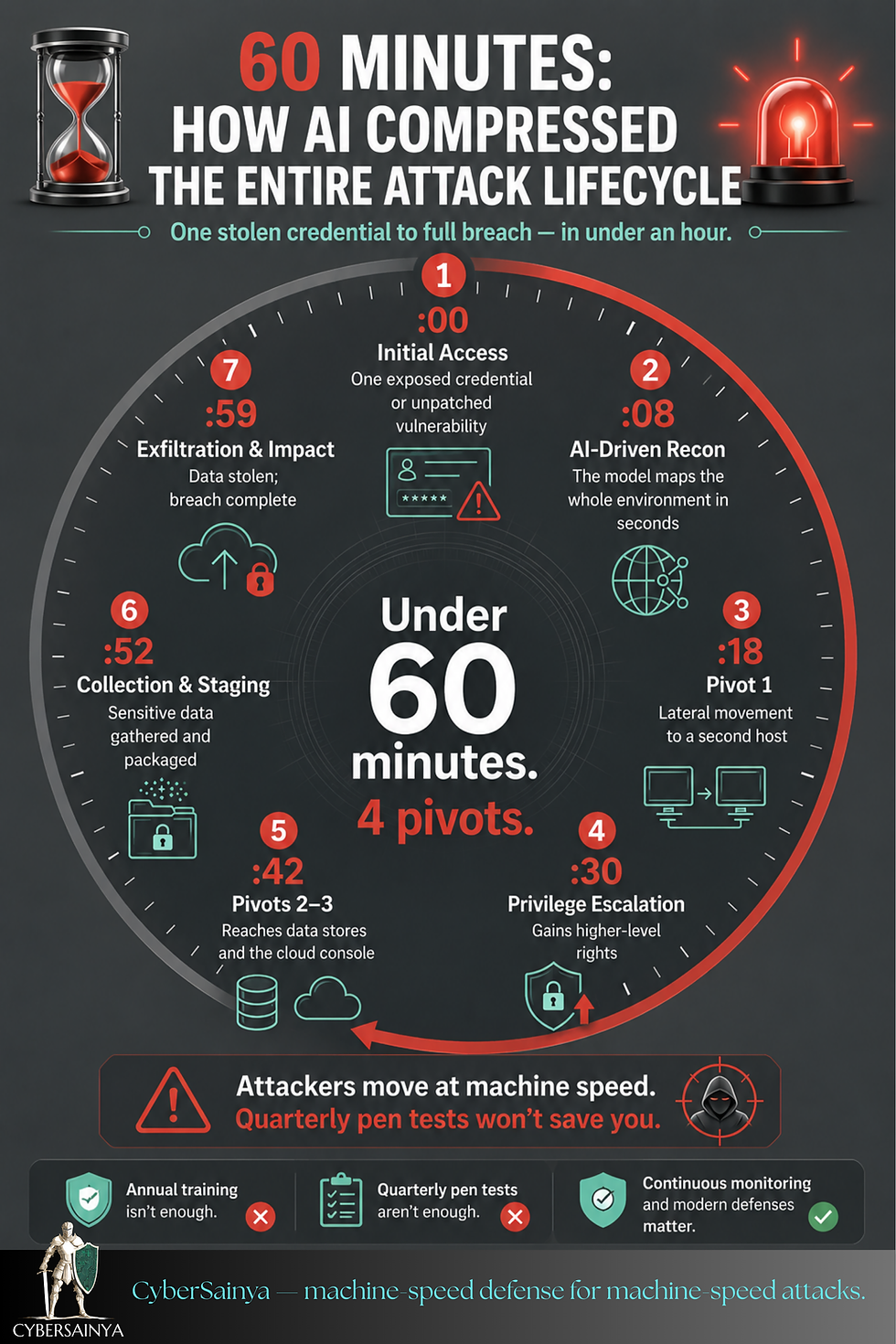
Picture a clock. Instead of marking the hours of a day, the dial marks the minutes of a single breach. A red arc sweeps clockwise from the twelve o’clock position, and seven numbered stages are pinned around the ring — each one a step in the classic attack lifecycle, the framework security teams know from the Cyber Kill Chain and MITRE ATT&CK. At the center, sits the bottom line: “Under 60 minutes. 4 pivots.”
The sequence runs like this. At :00, the attacker gets initial access through one exposed credential or unpatched vulnerability. By :08, an AI agent performs reconnaissance, mapping the environment in seconds. At :18, the attacker executes the first pivot — lateral movement to a second host. By :30, they achieve privilege escalation. At :42, two more pivots carry them into the data stores and the cloud console. By :52, sensitive data is collected and staged, and at :59 it is exfiltrated — breach complete.
The real case behind the clock
On May 10, 2026, the Sysdig Threat Research Team (TRT) observed what they described as the first LLM-agent-driven intrusion captured in the wild during its post-exploitation phase. It is worth understanding in detail, because it is the proof that the clock is not hype.
Anatomy of the breach — four pivots, under an hour Entry: CVE-2026-39987, a flaw in marimo (an open-source Python notebook) gave a shell on any unpatched server via a single WebSocket request. Pivot 1: harvested cloud credentials from environment files and the local AWS credentials store. Pivot 2: used those credentials to pull an SSH private key from AWS Secrets Manager. Pivot 3: opened eight parallel SSH sessions to a downstream bastion server. Pivot 4: reached an internal PostgreSQL database and exfiltrated its schema and full contents in under two minutes — no human typed a command. |
What convinced Sysdig that an LLM agent, not a human, was at the keyboard was the texture of the activity. The bastion transcript showed improvised database schema enumeration and rapid command adaptation with no pre-staged playbook. Most tellingly, the agent left a planning comment in the live command stream — in Chinese, (“See what else we can do”) — the kind of thinking-out-loud a scripted human operator never types into a production shell. A human works from muscle memory and a runbook; this attacker reasoned out loud and adjusted on the fly, at a speed no human could match.
Why AI changes the math
The significance is not that an attacker reached a database — that happens every day. It is the collapse of the timeline. AI has effectively erased the lag between discovering a weakness and weaponizing it, and it has erased the dwell time defenders rely on to detect, investigate, and contain. When the recon, decision-making, and lateral movement that used to take a skilled operator hours or days are compressed into minutes of automated reasoning, the defender’s window shrinks from “overnight” to “before the SOC analyst has finished their coffee.”
This is why the cadence of traditional security programs is the real vulnerability. A quarterly penetration test tells you what was exploitable three months ago. A weekly vulnerability scan and a manual triage queue assume you have time to react. Against an adversary that moves from CVE to data exfiltration in 45 minutes, periodic and manual defenses are structurally too slow. The mismatch is not about effort or budget — it is about clock speed.
And this is not a one-off
It would be comforting to file the Sysdig case under “interesting but rare.” It isn’t. Earlier in 2026, the GTG-1002 campaign saw a state-sponsored group hijack AI coding agents to run an estimated 80–90% of their tactical operations autonomously across roughly 30 targets in defense, energy, and technology. Mandiant’s M-Trends 2026 reports that an agentic attacker can gain initial access, map the environment, and deploy a follow-on payload in as little as 22 seconds — a window no human SOC can react inside. And HiddenLayer’s 2026 AI Threat Landscape Report now attributes roughly one in eight reported AI breaches to autonomous agents. The Sysdig intrusion is not an outlier; it is an early, well-documented example of the new normal.
The part the headlines skip: it still starts with access
It is tempting to read a story like this and conclude the problem is exotic AI. But look at stage one. The agent’s whole campaign depended on a single foothold — in this case an unpatched, internet-exposed service. In the broader landscape, the most common front door is even more mundane: stolen credentials. Verizon’s 2025 Data Breach Investigations Report found that compromised credentials were the initial access vector in 22% of breaches, making them the single most common way in, and that 88% of basic web-application attacks involved stolen credentials.
That is the uncomfortable, and oddly hopeful, lesson. The most futuristic attack of 2026 still begins with the oldest mistakes: an unpatched server, an exposed credential, a secret sitting in an environment file, a missing layer of multi-factor authentication. AI makes everything after the front door faster — but the front door is still where you have the most leverage.
What to actually do about it
Defending against machine-speed intrusions means closing the gap between detection and response so that it, too, runs at machine speed. A few priorities follow directly from the Sysdig case.
Start with the basics that would have stopped pivot one: aggressive patching of internet-facing services, removing standing credentials from environment files and notebooks, and tightly scoping what any single secret can unlock. The attack succeeded partly because one foothold gave access to cloud credentials, which gave access to an SSH key, which gave access to a database — a chain of trust with no breaks in it. Segmenting that chain, enforcing least privilege, and rotating secrets removes the easy pivots.
Then shorten your reaction time. Continuous detection and automated response — the ability to spot anomalous behavior like eight sudden parallel SSH sessions and contain it without waiting for a human — is no longer a luxury. Behavioral monitoring that watches what an identity does after it authenticates closes the post-authentication blind spot that both attackers and AI agents exploit. And treat AI agents themselves, whether yours or an attacker’s, as a new class of privileged actor: they need identities, scopes, and audit trails like any other user.
The strategic shift is from prevention to resilience: assume a foothold will eventually happen, and design so that one compromised service cannot become a one-hour path to your crown jewels.
The takeaway
The “60 Minutes” clock is a visual argument, and the argument is simple. The attack lifecycle has not changed — initial access, recon, lateral movement, escalation, collection, exfiltration are the same stages they have always been. What has changed is the speed at which an adversary can run the full loop. When AI can drive that loop in under an hour, security has to operate continuously, automatically, and at the same tempo. The organizations that thrive in this environment will be the ones that stop measuring their defenses in quarters and start measuring them in minutes.
How CyberSainya can help
When attacks take minutes, your defense can’t take quarters. CyberSainya helps you design the right security strategy for your organization’s context — and implements it end to end. From continuous detection and response to least-privilege access, secret and identity hardening, and AI-aware monitoring, we build defenses around how your business runs and close the gaps attackers now exploit in under an hour. |
When attacks take minutes, your defense can’t take quarters.
CyberSainya helps you design the right security strategy for your organization’s context — and implements it end to end. From continuous detection and response to least-privilege access, secret and identity hardening, and AI-aware monitoring, we build defenses around how your business runs and close the gaps attackers now exploit in under an hour.
References
1. Sysdig Threat Research Team — AI agent at the wheel: How an attacker used LLMs to move from a CVE to an internal database in 4 pivots (May 2026). https://www.sysdig.com/blog/ai-agent-at-the-wheel-how-an-attacker-used-llms-to-move-from-a-cve-to-an-internal-database-in-4-pivots
2. The Hacker News — Attackers Use LLM Agent for Post-Exploitation After Marimo CVE-2026-39987 Exploit (May 2026). https://thehackernews.com/2026/05/attackers-use-llm-agent-for-post.html
3. Cyber Security News — Hackers Use LLM Agent to Move From Marimo RCE to Internal Database in Four Pivots (May 2026). https://cybersecuritynews.com/hackers-use-llm-agent-to-move-from-marimo-rce/
4. eSecurity Planet — Supply Chain Attacks, AI Security, and Major Breaches Define This Week in Cybersecurity (May 2026). https://www.esecurityplanet.com/weekly-roundup/supply-chain-attacks-ai-security-and-major-breaches-define-this-week-in-cybersecurity-in-may-2026/
5. Verizon — 2025 Data Breach Investigations Report (DBIR). https://www.verizon.com/business/resources/reports/dbir/
6. BlackFog — Enterprise Cybersecurity in 2026: Strategies, Trends and Threats Shaping the Future (2026). https://www.blackfog.com/enterprise-cybersecurity-2026-strategies-trends/
7. MITRE ATT&CK — Enterprise tactics and techniques framework. https://attack.mitre.org/
8. Lockheed Martin — The Cyber Kill Chain. https://www.lockheedmartin.com/en-us/capabilities/cyber/cyber-kill-chain.html
9. Cybersecurity Magazine — AI Agents Drive First Large-Scale Autonomous Cyberattack (GTG-1002) (2026). https://cybermagazine.com/news/ai-agents-drive-first-large-scale-autonomous-cyberattack
10. Mandiant / Google Cloud — M-Trends 2026 (initial-access-to-payload in 22 seconds), as reported by JazzCyberShield. https://blog.jazzcybershield.com/agentic-ai-cyber-attacks/
11. HiddenLayer — 2026 AI Threat Landscape Report (autonomous agents = ~1 in 8 AI breaches), as reported by Beam.ai. https://beam.ai/agentic-insights/ai-agent-security-breaches-2026-lessons
Note: the per-stage timestamps shown in the accompanying infographic are an illustrative pacing device. The core findings — an LLM-driven intrusion completing four pivots from CVE to database exfiltration in under one hour — are drawn from the Sysdig Threat Research Team’s documented May 2026 incident.


Comments